
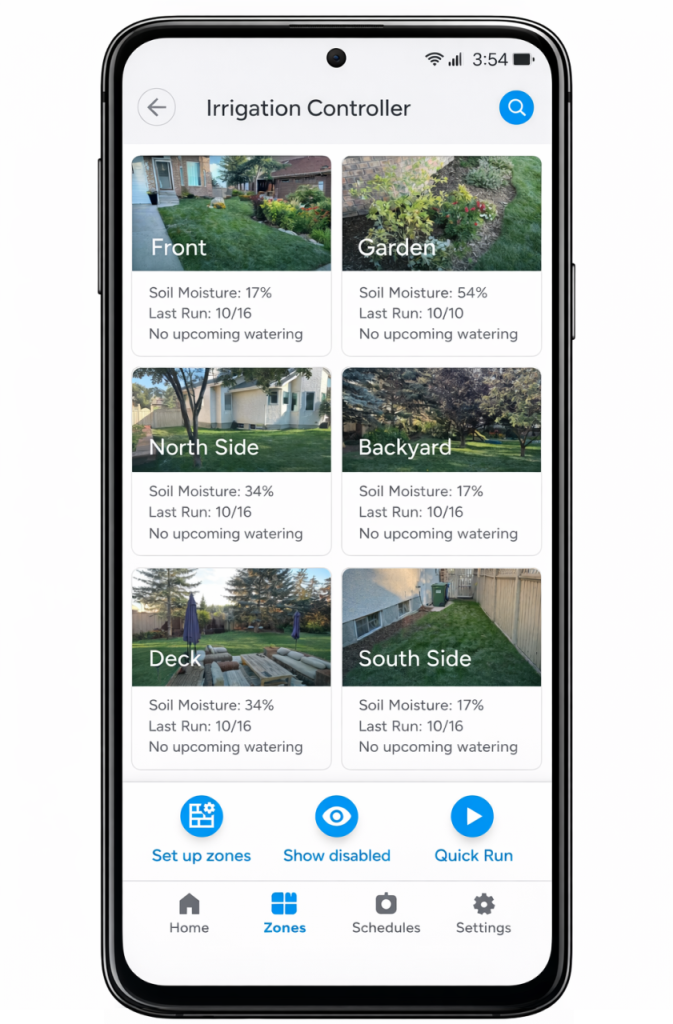
Smart irrigation Scheduling

The Future Green Difference: Demand-Based Watering

Most irrigation systems apply the same amount of water week after week, regardless of changing weather, soil conditions, or sprinkler performance. At Future Green Irrigation, our approach replaces rigid schedules with soil-driven irrigation and intelligent control, allowing water to be applied only when and where it’s truly needed.

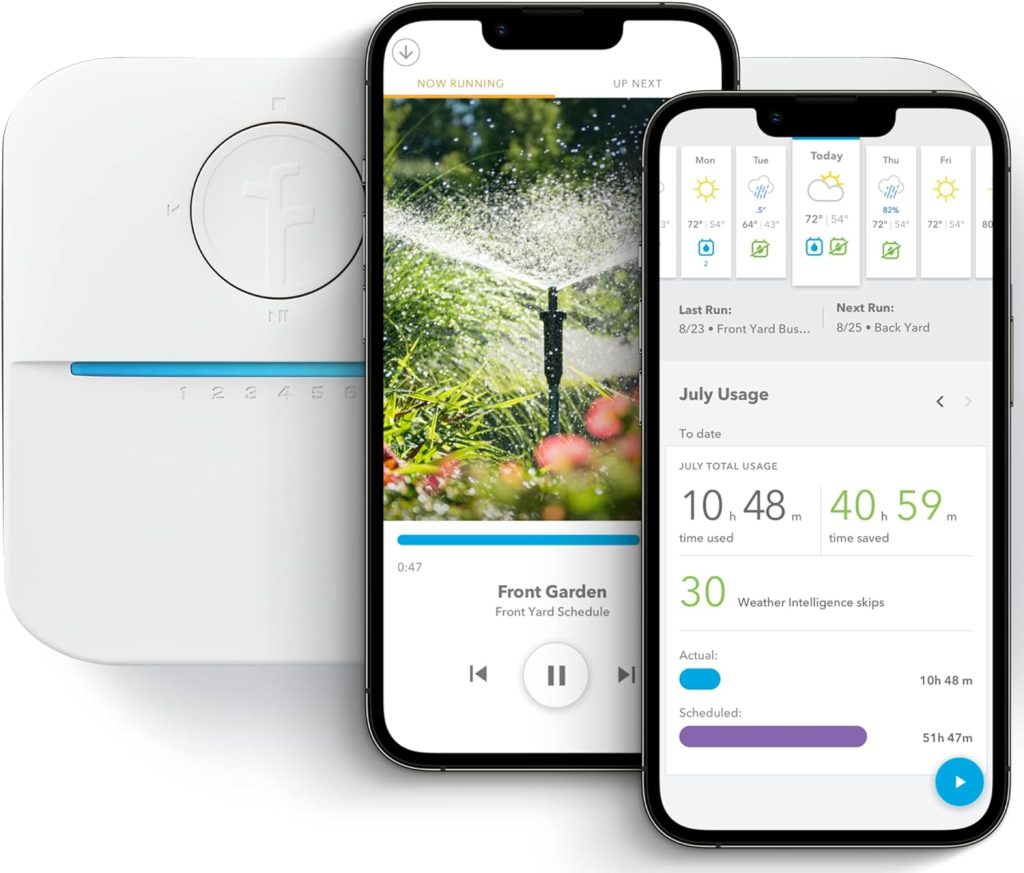
Powered by Rachio Smart Controller

Soil-Based Scheduling Driven By Real Data

Rachio smart controllers make demand-based irrigation possible by combining hyper-local weather data, soil modeling, and real-time forecasts.

Instead of watering on a rigid schedule, Rachio continuously estimates how much moisture remains in the soil and irrigates only when plants actually need it. When paired with accurate system design and zone data, this intelligence allows irrigation to respond to real conditions — not assumptions. 

Smart Irrigation At a Glance

Watering Should Respond To The Landscape, Not The Calender

🚫

Traditional Irrigation Watering

Fixed schedules

  • Water 3 days per week
  • Same run time every cycle
  • Rule-of-thumb watering times
  • Ignores weather conditions
  • lgnores soil conditions
⚠️
Result Overwatering, runoff, wasted water, stressed plants

The Future Green Difference

Soil-based watering

  • Water only when needed
  • Adjusts daily to weather
  • Uses real sprinkler performance data
  • Uses real plant demand
  • Tracks soil moisture
🌿
Result Healthier landscapes with significantly less water
🪣

Your Soil Is a Water Tank

After watering, moisture is stored in the soil. Plants draw from that “tank” every day — but not at the same rate.

Think of the gas tank in your car:

  • Drive more → refill sooner
  • Drive less → refill later

You don’t refill on a schedule — you refill when it’s needed.

🌦

Why Water Use Changes Daily

Plant water use changes constantly based on:

  • Temperature
  • Sun exposure
  • Wind
  • Humidity
  • Rainfall
Hot, dry days use up the tank faster • Cool, cloudy days use it up slower
Fixed schedules can’t keep up — smart systems can.
🧠

How Rachio Decides When to Water

Rachio doesn’t ask “What day is it?” It asks “How much moisture is left in the soil?”

Using:

  • Hyper-local weather data
  • Rainfall tracking
  • Forecasts
  • Plant type
  • Soil type
  • Sun exposure

Rachio estimates how quickly moisture is being used and only refills the soil when it reaches a calculated threshold.

📐

Why Accurate Design Data Matters

Smart controllers are only as good as the information they’re given.

We design every system using professional CAD irrigation software that provide:

  • Exact zone area
  • Manufacturer-specific sprinkler precipitation rates
  • Soil water holding capacity

This data comes from a professional contractor database — not rule-of-thumb guessing.

This accuracy allows Rachio to:

  • Calculate precise run times
  • Prevent runoff
  • Match water output to real demand
  • Maximize water savings
🆚

Traditional Irrigation vs Future Green Smart Scheduling

A quick side-by-side:

Traditional Irrigation Future Green Smart Scheduling
Fixed schedules Demand-based watering
Guesswork run times Engineered precision
Overwatering common Water only when needed
Wasted water Efficient & adaptive
Calendar-driven Soil-driven

💧 The Bottom Line

Traditional irrigation waters by habit. Smart irrigation waters by need. By combining professional design data, advanced soil moisture modeling, and real-world weather intelligence, we deliver a smarter, more efficient irrigation system that protects your landscape — and your water bill.

Smart Irrigation A Deeper Look

The Science Behind Demand Based Watering

At Future Green Irrigation, we know that smart irrigation isn’t just about when water is applied — it’s about how plants access water below the surface. Demand-based watering works because it is rooted in soil science, plant physiology, and accurate system design.

Using the Rachio smart controller as the control platform, we apply these principles to manage soil moisture in the root zone rather than watering on fixed schedules. The result is irrigation that responds to real conditions below the surface — not assumptions.

Deeper Roots = A Larger Water Tank

We often describe soil as a water tank — and root depth determines how large and reliable that tank is.

  • Shallow roots access a small, shallow volume of soil
  • Deep roots access a much larger volume
  • Larger soil volume = more stored water
  • Deeper soil dries slower and holds moisture longer

Frequent, shallow watering keeps roots near the surface, where moisture is quickly lost. Properly managed irrigation encourages roots to grow deeper — increasing drought tolerance and overall plant health.

Deep root zone illustration

Field Capacity: When the Tank Is Full

After irrigation or rainfall, soil holds water between its particles. Field capacity is the amount of water the soil can retain after excess water has drained away.

  • Soil pores contain both air and water
  • Roots can easily access moisture
  • Oxygen remains available for healthy root growth

This represents a full but healthy tank — not saturated and not dry.
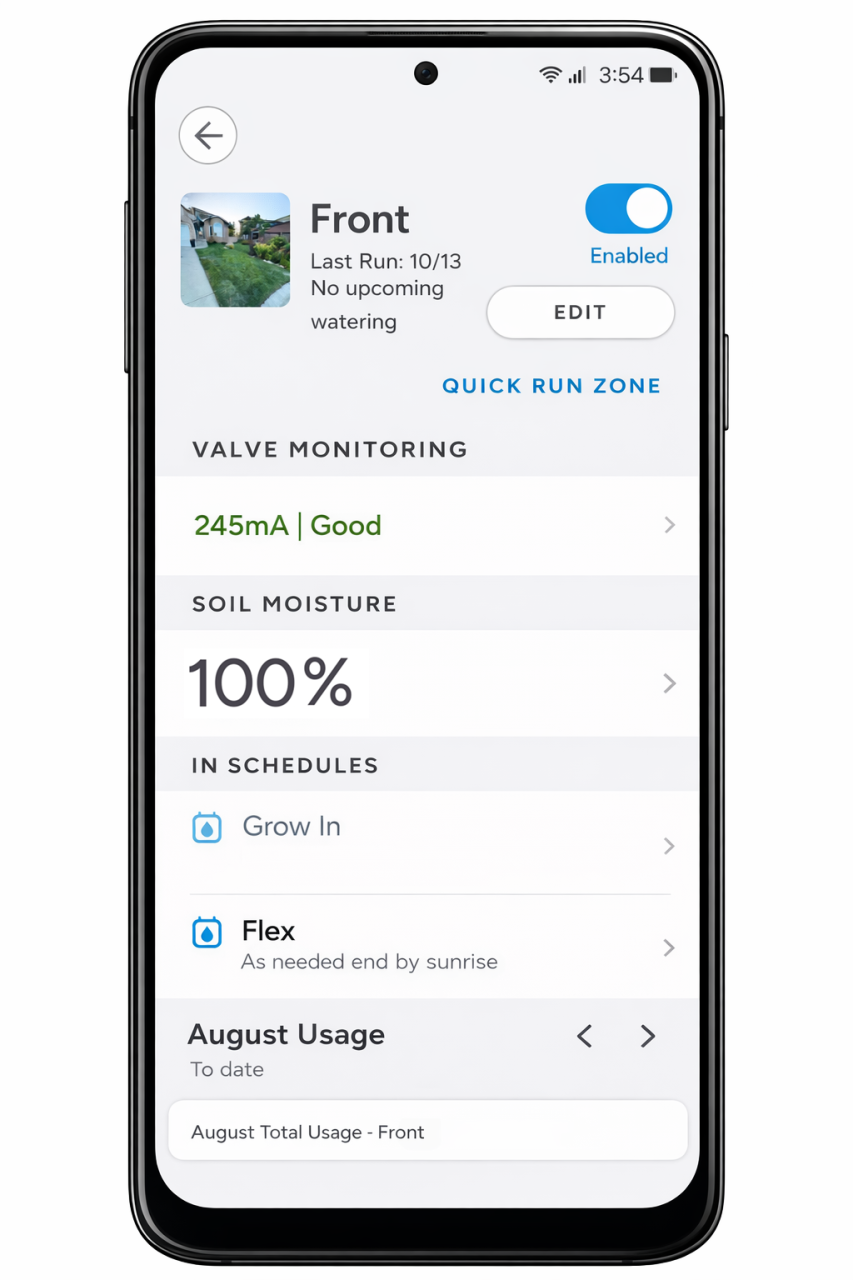
Soil moisture and field capacity zone details
Field capacity is represented by a soil moisture level of 100%, indicating the soil is fully replenished.

Water Depletion Happens Gradually

As plants use water, evapotranspiration (ET) occurs. This is the combined loss of water through soil evaporation and plant transpiration.

  • Soil moisture decreases
  • Water becomes harder for roots to extract
  • The “soil tank” slowly empties

This process is normal and expected but doesn’t happen at a constant rate. Rachio’s advanced soil moisture modeling estimates the rate of depletion using:

  • Hyper-local weather data
  • Rainfall tracking
  • Forecasts
  • Plant type
  • Soil type
  • Sun exposure

The key is knowing how far to let the tank deplete before refilling it.

Allowed Depletion: Knowing When to Refill

Allowed depletion is the percentage of stored soil moisture that can be safely used before plants begin to experience stress. Beyond this point soil moisture still exists but is held more tightly by soil particles and becomes difficult for roots to access.

Why We Use 50% Allowed Depletion

We configure our systems to refill the soil at approximately 50% allowed depletion.

This approach:

  • Encourages deeper, healthier root systems
  • Maintains consistent plant health
  • Maximizes overall water efficiency

At the 50% level:

  • Roots can still access moisture easily
  • Plant stress is avoided

Allowing greater depletion may reduce watering frequency slightly, but often leads to increased plant stress, reduced turf quality, and slower root development. Refilling sooner provides no benefit and commonly results in shallow roots and wasted water.
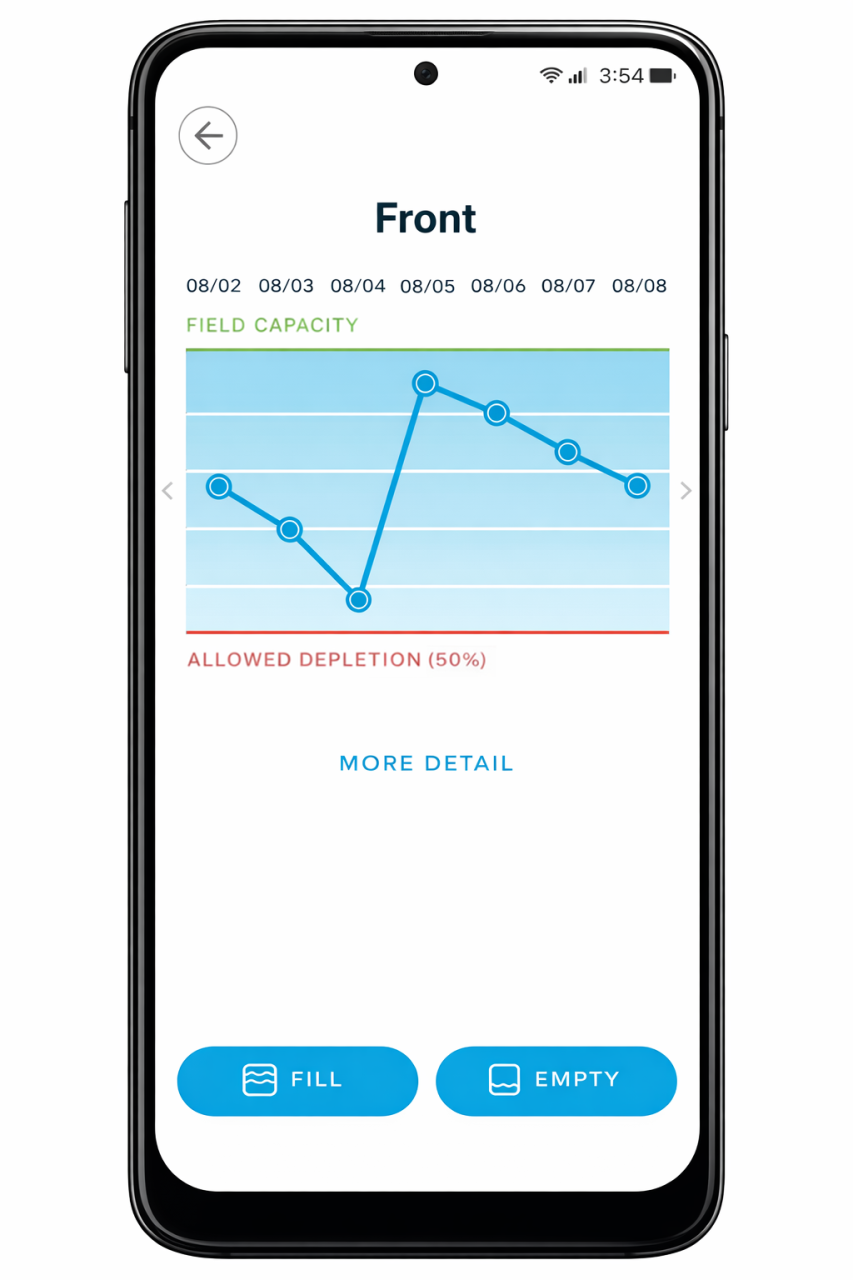
Allowed depletion chart
Moisture is managed between field capacity and the allowed depletion refill threshold.

Why Accurate Sprinkler Data Matters

Demand-based irrigation only works when the system knows exactly how much water is being applied. Smart controllers do not guess — they calculate.

That calculation depends on accurate inputs for each irrigation zone, including:

  • Precipitation rate (how quickly water is applied)
  • Irrigated area
  • Soil water holding capacity (based on soil type)

Without accurate data, even the most advanced controller cannot function properly.

How We Provide the Right Inputs

Every irrigation system installed by Future Green Irrigation is designed using professional CAD irrigation software supported by a contractor-grade sprinkler performance database.

For each zone, this allows us to define:

  • Manufacturer-specific precipitation rates
  • Accurate irrigated area measurements
  • Verified sprinkler and nozzle performance

This level of precision goes far beyond generic assumptions or traditional rule-of-thumb programming.
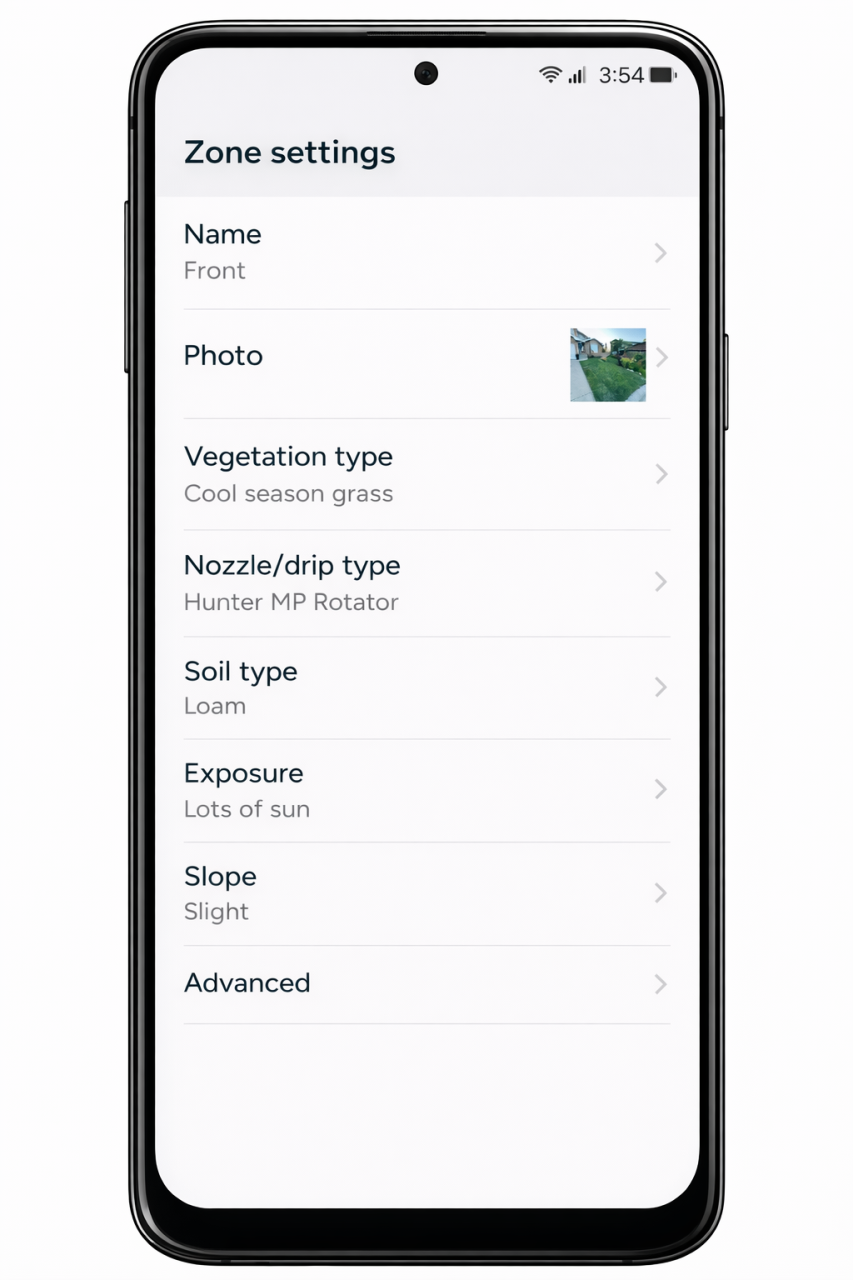
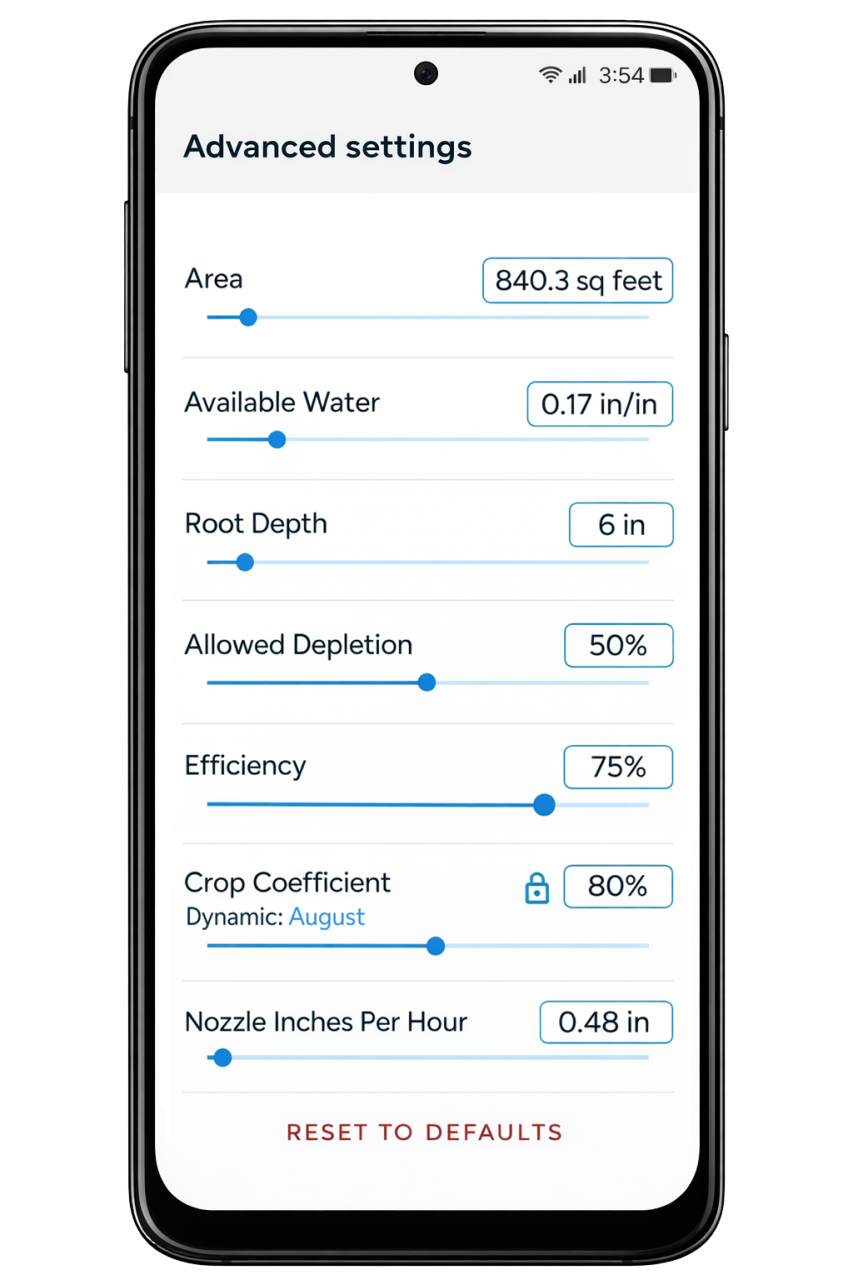
Zone settings
Basic zone settings — accurate zone info starts here.
Advanced settings
Advanced inputs — the details that enable precise soil-based scheduling.

How Intelligent Controllers Use This Information

With accurate design data in place, the controller can:

  • Calculate exactly how much water each zone applies per minute
  • Translate soil moisture needs into precise run times
  • Refill the soil back to field capacity — not beyond it
  • Calculate accurate total water usage

This allows our systems to:

  • Prevent runoff
  • Avoid overwatering
  • Match irrigation output to real plant demand
  • Provide accurate water use reporting

High-quality inputs enable intelligent decisions. Poor inputs force guesswork.

Garbage In = Garbage Out

  • Incorrect precipitation rates cause over- or under-watering
  • Incorrect area sizes distort total water usage
  • Guesswork undermines efficiency and performance

This is why we treat system design as a critical part of the installation — not a rough sketch on a piece of paper.

Unlimited Snow Removal

Flat Monthly Rate

Check your personalized price in seconds — no obligation. If it looks good, select your start and end dates (1-month minimum), enter your info, and sign up for worry-free snow removal this winter. A representative will then contact you to confirm and set everything up.